
Recent Posts
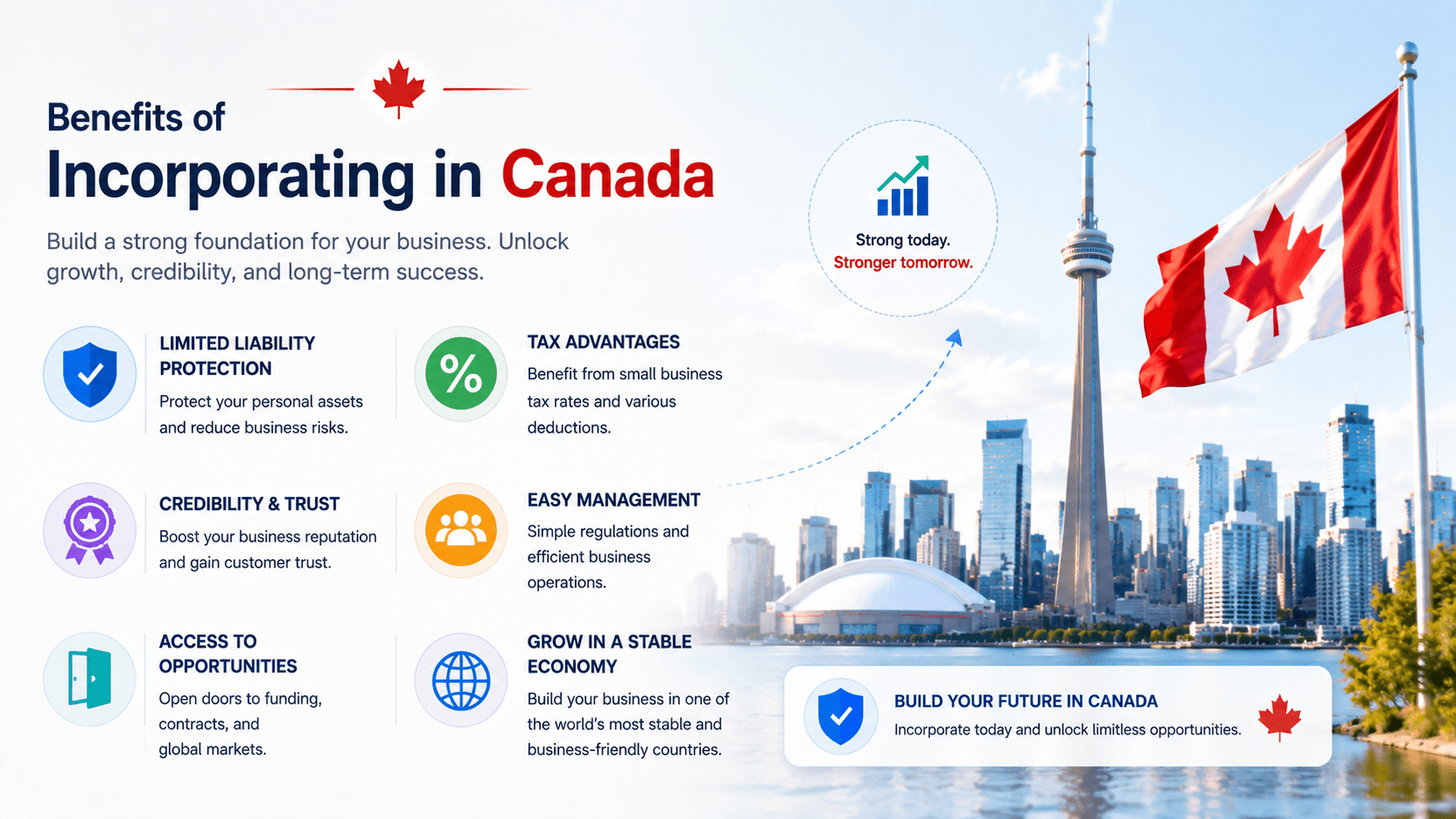
Benefits of Incorporating in Canada
Starting a business in Canada can be an exciting and rewarding journey, but choosing the right business structure is essential for long-term success. Many entrepreneurs begin as sole proprietors because the process is simple and affordable. However, as the business grows, incorporation often becomes a smarter option. Incorporating a business in Canada provides several legal, financial, and operational advantages that can help businesses grow with greater stability and confidence.
Canada is recognized globally as one of the most business-friendly countries due to its strong economy, transparent legal system, and supportive environment for entrepreneurs. Whether you are launching a startup, opening a consulting company, or planning to expand internationally, incorporation can create a solid foundation for future growth.
Limited Liability Protection
One of the biggest benefits of incorporating in Canada is limited liability protection. When a business becomes incorporated, it is treated as a separate legal entity from its owner. This means the corporation is responsible for its own debts and legal obligations.
For business owners, this separation helps protect personal assets such as savings, property, and investments if the company faces lawsuits or financial difficulties. In a sole proprietorship, the owner can be personally responsible for business liabilities, which increases financial risk.
This protection is especially valuable for businesses operating in industries such as consulting, technology, construction, and international trade, where legal or financial risks may arise during operations.
Tax Benefits and Financial Flexibility
Another major advantage of incorporation in Canada is the potential for tax savings. Corporate tax rates are generally lower than personal income tax rates, allowing incorporated businesses to retain more profits for growth and expansion.
Incorporation also provides flexibility in managing income. Business owners can choose to receive earnings through salary, dividends, or a combination of both, depending on what works best for their financial goals. This flexibility can improve cash flow management and support long-term tax planning.
Increased Professional Credibility
Incorporating a business can significantly improve its professional image. Customers, suppliers, investors, and financial institutions often view incorporated companies as more stable and trustworthy compared to sole proprietorships.
Using terms such as “Inc.”, “Ltd.”, or “Corp.” after a company name creates a stronger sense of professionalism and commitment. This can help businesses build better relationships with clients and improve opportunities for partnerships and contracts.
For companies planning to work with larger organizations or clients, incorporation may also improve credibility and business opportunities.
Easier Access to Funding
As businesses grow, access to funding becomes increasingly important. Incorporated businesses often have a better chance of securing loans, attracting investors, and raising capital.
A corporation can issue shares to investors, making it easier to bring in external funding for expansion and operations. Financial institutions also tend to view incorporated companies as more organized and financially reliable, which may improve approval chances for business financing.
For startups and expanding businesses, incorporation creates a stronger structure for attracting investors and supporting future growth.
Business Continuity and Long-Term Stability
Unlike sole proprietorships, incorporated businesses continue to exist even if ownership changes. A corporation has perpetual existence, meaning the business can continue operating regardless of changes in shareholders or management.
This creates long-term stability and makes it easier to transfer ownership, add business partners, or plan future succession. If the founder retires or decides to sell the company, the corporation can continue operating without major disruption.
This advantage is particularly important for entrepreneurs who want to build businesses with long-term value and future expansion plans.
Better Opportunities for Growth
Canada’s corporate structure is respected internationally, which can benefit businesses planning to expand into global markets. Incorporation helps create a more organized structure for scaling operations, hiring employees, and managing larger business activities.
Federal incorporation can also provide name protection across Canada, helping businesses strengthen their brand identity while expanding into different provinces.
As companies grow, incorporation offers greater flexibility for restructuring ownership, bringing in investors, and managing future expansion opportunities more efficiently.
Strong Canadian Business Environment
Canada offers a stable economy, transparent regulations, and strong legal protections for businesses. Entrepreneurs benefit from reliable banking systems, skilled workers, and access to international markets, making Canada an attractive place for business growth.
The country also supports innovation and entrepreneurship through various business programs and trade opportunities, helping businesses compete both locally and globally.
Conclusion
Incorporating in Canada offers several important advantages for businesses looking to grow professionally and securely. From limited liability protection and tax benefits to improved credibility and easier access to funding, incorporation provides a strong foundation for long-term success.
Although incorporation comes with additional legal and accounting responsibilities, the long-term benefits often outweigh the costs for growing businesses. For entrepreneurs planning expansion, investment opportunities, or long-term stability, incorporation can be a smart business decision.
If you are considering incorporating your business in Canada, seeking professional guidance can help ensure the process is smooth, compliant, and aligned with your business goals.
Complete Consulting Canada — Helping You Build and Manage Your Canadian Business from Anywhere.
Frequently Asked Questions
Incorporating a business means creating a separate legal entity from the business owner. The corporation can own assets, enter contracts, and be responsible for its own debts and liabilities.
Some of the biggest benefits include limited liability protection, lower corporate tax rates, improved credibility, easier access to funding, and better opportunities for long-term business growth.
It depends on the size and goals of the business. Sole proprietorships are easier to set up, but incorporation provides stronger legal protection and tax advantages for growing businesses.
Yes, non-residents can incorporate a business in Canada, although requirements may vary depending on the province and business structure.
The cost depends on whether the business is incorporated federally or provincially and whether professional legal or consulting services are used during the process.
In many cases, yes. Corporate tax rates are generally lower than personal income tax rates, and eligible businesses may qualify for the Small Business Deduction.
Yes, incorporated businesses must file annual returns, maintain corporate records, and comply with Canadian tax and legal requirements.
Yes. One of the key advantages of incorporation is business continuity. The corporation continues to exist even if ownership or management changes.